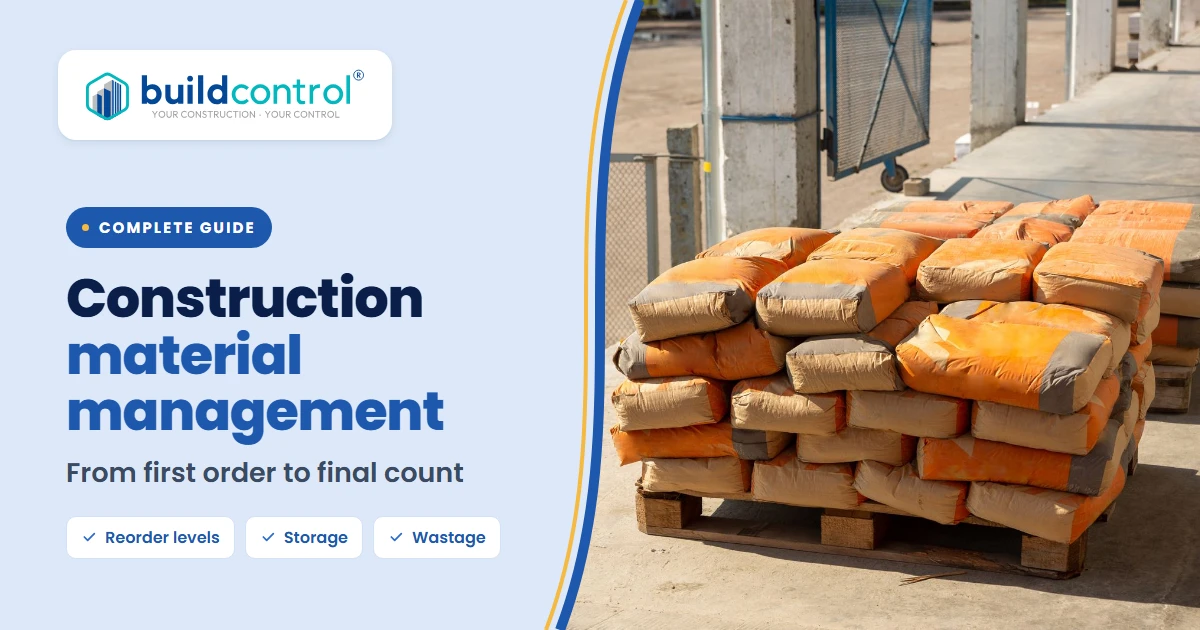
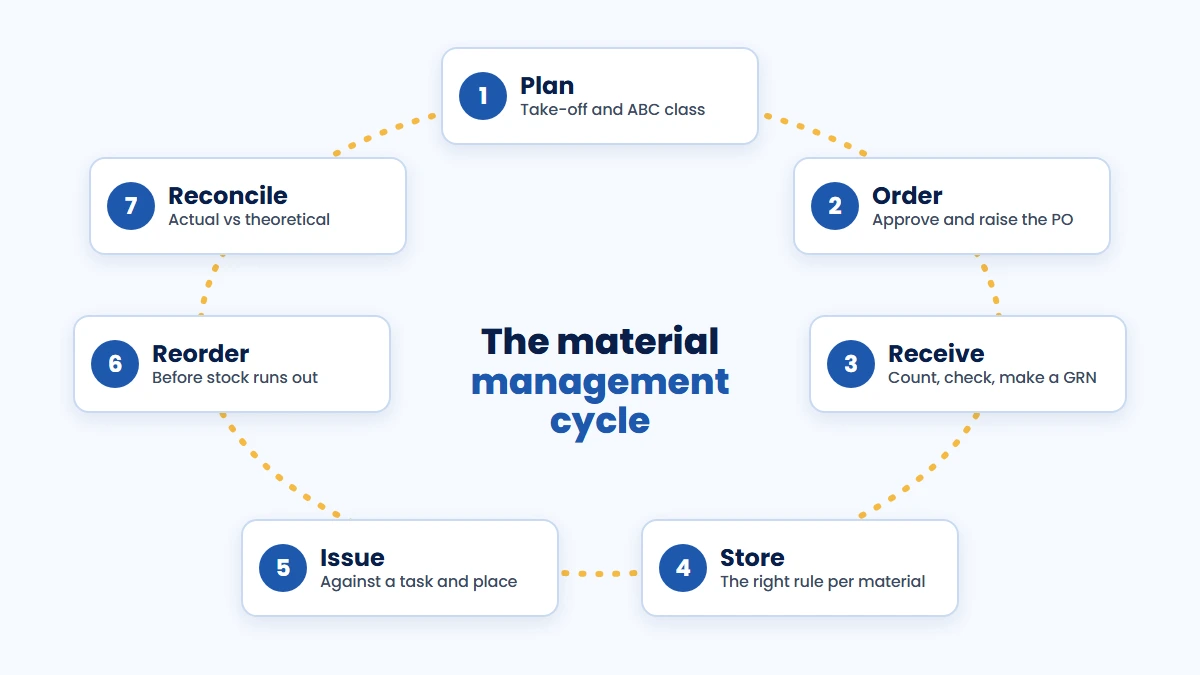
Construction material management is how a contractor plans, orders, receives, stores, issues and reconciles every material a project uses. Done well, the right cement, steel, blocks and fittings are on site on the day they are needed, and the quantity you paid for matches the quantity built into the work. This guide walks through the full cycle in seven steps, with the formulas, site checklists and worked examples you can use on your own projects.
What is construction material management?
Construction material management is the process of planning, buying, receiving, storing, issuing and reconciling materials so that each site has what it needs, in the right quantity and quality, at the lowest total cost. It starts with the quantities in the drawings and ends when stock on paper agrees with stock in the store.
Every day it should answer five questions: what have we ordered, what has arrived, what is in the store, where did the rest go, and what must be ordered next. If a site cannot answer all five without a phone call, material money is probably leaking somewhere.
Where material money leaks on site
A single theft is easy to notice. Most losses are smaller, happen daily and look like normal consumption:
| Leak | What it looks like on site | What fixes it |
|---|---|---|
| Short deliveries | The challan says 400 bags, nobody counts, 385 were unloaded | Count, weigh or measure before signing |
| Paying for what never came | The invoice is paid against the order, not against what was received | Match order, goods receipt and invoice |
| Over-ordering | Leftover tiles, blocks and paint at handover | Order from a take-off, with a set wastage allowance |
| Damage in storage | Damp cement, chipped tiles, rusted steel | A storage rule for each material, first in first out |
| Issues without a record | Gangs help themselves and stock is guessed at month end | An issue slip that names the gang, task and location |
| Rework | Defective work is broken out and the material is used twice | Quality checks at each stage, with rework logged separately |
| Late orders | A crew waits, or pays a premium for a same-day purchase | Reorder levels based on daily use and lead time |
Step 1: Plan quantities from the drawings
Take off quantities from the approved drawings or bill of quantities, then split them by activity and by week using the project schedule. The result is a material schedule: what is needed, how much, where and when. Add a wastage allowance to each item, agreed in advance and written down, so that site teams are measured against a number rather than a feeling.
You do not need to control every item equally. ABC analysis sorts materials by the money they represent:
| Class | Typical items | How tightly to control them |
|---|---|---|
| A: few items, most of the value | Reinforcement steel, cement or ready-mix concrete, facade, lifts | Count weekly, reconcile every month, approve every order |
| B: moderate value | Blocks, tiles, pipes, cables, doors and windows | Count every two weeks, reconcile at each stage |
| C: many items, little value | Nails, binding wire, sealants, consumables | Simple minimum and maximum stock, checked monthly |
Classify from your own bill of quantities, because the mix changes from project to project. On an interior fit-out, tiles and joinery may be class A items.
Step 2: Request, approve and order
Keep the route from need to order short and always the same: the site raises a request (often called an indent), the store checks existing stock, the project manager approves, and purchase places the order. Checking stock first matters, because another site may already hold what you are about to buy.
A purchase order that prevents arguments later states:
- Exact specification: grade, size, brand or standard, not just "cement" or "pipe"
- Quantity and unit, with any accepted tolerance
- Rate, taxes, transport and who pays for unloading
- Delivery date or dates, and the site address
- Test certificates required with the delivery
- How shortages, damage and rejected material will be handled
Step 3: Receive and check every delivery
The gate is the cheapest place to catch a problem. Once the truck has left, a short or damaged load becomes your word against the supplier's. Record each delivery on a goods receipt note (GRN), which states what was accepted rather than what was sent.
Delivery checklist for the store keeper
- The purchase order number on the delivery note is valid and still open
- Specification matches: grade, size, brand, batch and manufacturing date
- Quantity is counted, weighed or measured before anyone signs
- Damage is photographed on the vehicle, before unloading where possible
- Test certificates are collected and samples set aside where testing applies
- Rejected material is listed on the delivery note and kept separate
- The GRN is made the same day, with vehicle number, time and the receiver's name
For steel, check the weight as well as the count. The standard approximation for a round bar is:
Bar weight (kg per metre) = diameter in mm × diameter in mm ÷ 162
A 16 mm bar weighs 16 × 16 ÷ 162, about 1.58 kg per metre. A load of 40 bars, each 12 m long, is 480 m, so it should weigh close to 758 kg. Compare this with the weighbridge slip and ask about any gap that is beyond the rolling tolerance in the standard you bought to.
For materials that need lab results, see why material testing reports are critical for quality and compliance.
Use a three-way match before paying
Before an invoice is approved, compare three documents: the purchase order (what you agreed to buy and the rate), the GRN (what you accepted) and the invoice (what you are asked to pay for). If 400 bags were ordered, 385 accepted and 400 billed, pay for 385 and raise the difference with the supplier. This check belongs in your payment approval process, not at month end.
Step 4: Store materials so they stay usable
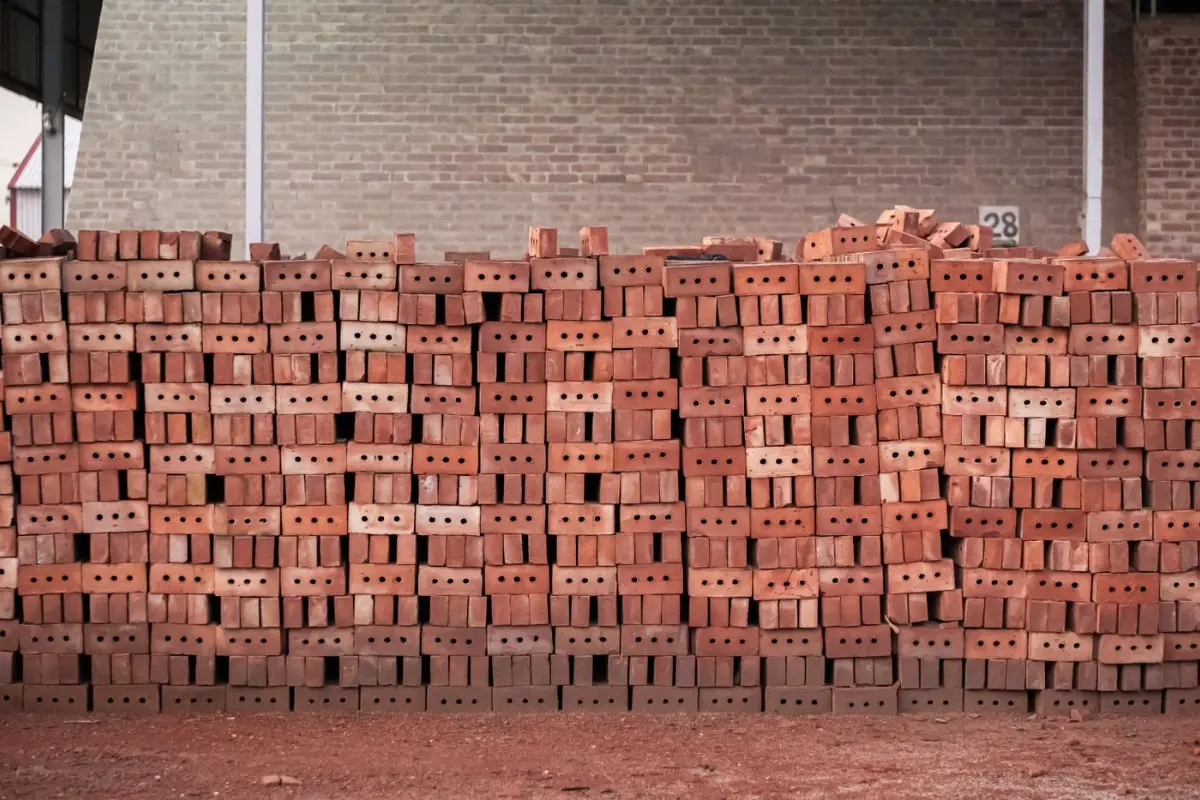
Poor storage turns good material into waste. Each material fails in its own way, so each needs its own rule:
| Material | How to store it | What ruins it |
|---|---|---|
| Cement bags | Dry, closed shed on raised pallets, clear of the walls, stacks about 10 bags high, oldest used first | Moisture and age; test before use if stored for more than about three months |
| Reinforcement steel | Off the ground on sleepers, sorted and tagged by diameter and grade | Mud, standing water and mixed bundles |
| Sand and aggregate | Hard, drained base with dividers between sizes | Mixing with soil, run-off in rain |
| Bricks and blocks | Level ground in stable, countable stacks near the point of use | Double handling and toppled stacks |
| Tiles and sanitary ware | Covered area, boxes on edge as marked, shade and batch visible | Breakage and mixed batches |
| Paints and chemicals | Cool, ventilated, locked store, with safety data sheets and expiry dates | Heat, expired shelf life, open flames nearby |
| Cables, fittings, hardware | Locked, labelled racks, issued only by the store keeper | Theft and untracked small issues |

If you run a central store as well as site stores, read our guide to construction warehouse management.
Step 5: Issue against a task, not just a name
The issue is where control is usually lost, because the material leaves the store and the story ends. A useful issue slip records the date, material and quantity, the gang or subcontractor, the task and location, who issued it and who received it. "20 bags, masonry gang" explains nothing. "20 bags, block work, second floor, flat 204" can be compared with the work done.
- Issue for a day's planned work, not for the week.
- Ask for unused material to be returned at the end of the shift, and record the return.
- Log breakage and wastage separately from consumption, with the reason.
- Treat a site-to-site transfer as two entries: out of one store and into the other, both signed.
Tie each day's issues to the daily site report so that material used and work done are recorded side by side.
Step 6: Set reorder levels before you run out
A reorder level is the stock at which a new order must be placed for the delivery to arrive before work stops.
Reorder level = average daily use × supplier lead time in days + safety stock
Say a site uses 120 bags of cement a day, the supplier takes 4 days to deliver, and you keep 2 days of use as safety stock. The reorder level is 120 × 4 + 240 = 720 bags. When stock falls to 720, order. Update the figure as the work changes, because a slab cycle and a finishing phase use very different quantities.
Do not protect yourself by simply ordering more. Excess stock ties up cash, takes up space and ages. If suppliers are the problem, look at how tracking material delays keeps projects on time.
Step 7: Reconcile what you used with what you built
Reconciliation is the step most sites skip, and the only one that proves the other six are working. It compares actual consumption with theoretical consumption, which is the quantity the completed work should have needed.
Actual consumption = opening stock + received − transferred out − closing stock counted
Wastage (%) = (actual consumption − theoretical consumption) ÷ theoretical consumption × 100
Worked example: monthly cement reconciliation
The figures are illustrative. During the month the site placed 200 m³ of concrete with a mix using 350 kg of cement per m³, which is 7 bags of 50 kg. No other work used cement.
| Item | Bags |
|---|---|
| Opening stock | 150 |
| Received on GRN | 1,600 |
| Transferred to another site | 100 |
| Closing stock, physically counted | 190 |
| Actual consumption (150 + 1,600 − 100 − 190) | 1,460 |
| Theoretical consumption (200 × 7) | 1,400 |
| Excess | 60 |
Wastage is 60 ÷ 1,400 × 100, about 4.3%. That number alone does not tell you where to look. The issue slips do:
- Issued according to the slips: 1,440 bags. Stock on paper should therefore be 150 + 1,600 − 100 − 1,440 = 210 bags. The count found 190, so 20 bags left the store without a record. This is a store problem.
- Used on the work: 1,440 bags against 1,400. The site used 40 more than the mix needed. If your agreed allowance is 2%, or 28 bags, then 12 bags need an explanation, such as thicker slabs, spillage or a wrong mix. This is a site problem.
The total of 60 bags splits into 28 allowed, 12 to investigate on site and 20 to investigate in the store. Two different conversations, with two different people.
Reconciling reinforcement steel
Steel is easier to trace because scrap can be weighed. Opening stock plus receipts should equal the steel installed (from the bar bending schedule), plus stock counted, plus reusable offcuts, plus scrap weighed. If 52.0 tonnes were available, and you can account for 44.2 installed, 6.1 in stock, 0.5 in reusable offcuts and 0.9 in scrap, the total is 51.7. The missing 0.3 tonnes needs an answer before the next order is approved.
Five numbers to review every month
| Measure | How to calculate it | What it tells you |
|---|---|---|
| Wastage against allowance | Actual wastage % compared with the agreed % | Whether site use is under control |
| Stock accuracy | Items where count equals book ÷ items counted × 100 | Whether records can be trusted |
| On-time, in-full delivery | Orders delivered complete and on time ÷ orders due × 100 | Which suppliers to keep |
| Days of stock | Current stock ÷ average daily use | Cash tied up, or a shortage coming |
| Emergency purchases | Number and value of unplanned buys | How good the planning is |
Who is responsible for what
- Planning or site engineer: quantities, the material schedule and theoretical consumption.
- Store keeper: receiving, GRNs, storage, issues and counts.
- Purchase team: quotes, orders and supplier follow-up.
- Project manager: approvals and the monthly reconciliation.
- Accounts: the three-way match and payment.
Keep ordering, receiving and paying with different people where you can. When one person does all three, errors and fraud have nothing to stop them.
How buildcontrol helps you manage materials
buildcontrol's material management module puts the steps above into one app shared by the office, the store and every site:
- Purchase orders and GRN: raise orders, record goods received and match them against what was ordered.
- Live stock ledger: every receipt and issue updates stock, so the number on screen reflects the store.
- Issue tracking: record what was issued, to whom and for which task.
- Wastage recording: logged separately, so it shows in reports instead of hiding inside consumption.
- Multiple stores and returns: central and site stores, with transfers and returns tracked between them.
- Reorder flags: items below their reorder level are flagged before the site runs dry.
Materials sit next to quality checks, payments and daily reports in the same app, and the same discipline applies to machines, as covered in our guide to construction equipment management.
Frequently asked questions
What is construction material management?
It is the process of planning, buying, receiving, storing, issuing and reconciling materials so that each site has what it needs, in the right quantity and quality, at the lowest total cost.
How do I calculate material wastage in construction?
Subtract theoretical consumption from actual consumption, divide by theoretical consumption and multiply by 100. If the work needed 1,400 bags of cement and 1,460 were consumed, wastage is about 4.3%.
How do I calculate the reorder level for a material?
Multiply average daily use by the supplier lead time in days, then add safety stock. At 120 bags a day, 4 days of lead time and 240 bags of safety stock, the reorder level is 720 bags.
What is a GRN in construction?
A goods receipt note (GRN) is the record made when a delivery arrives. It states what was actually accepted, after counting and checking, and is matched with the purchase order and the invoice before payment.
What is material reconciliation?
It compares the material a site actually consumed with the quantity the completed work should have needed. The difference is wastage, and issue records show whether it happened in the store or on the work.
How can I reduce material waste on site?
Order from a take-off with an agreed allowance, count every delivery, store each material correctly, issue against a task for one day at a time, log wastage with its reason and reconcile high-value items every month.
Can buildcontrol track materials across several stores?
Yes. You can maintain a central store and site-level stores, and transfers between them are tracked so that stock is not counted twice.
Conclusion
Material control does not need a complicated system. It needs a planned quantity, a counted delivery, a sensible store, an issue slip that names the task and a reconciliation every month. Start with your class A items, usually steel and cement, and run one honest reconciliation this month. The gap it shows will tell you which step to fix first.
See buildcontrol on your own sites
Book a free demo and we will walk you through it on your projects.
Book a free demo